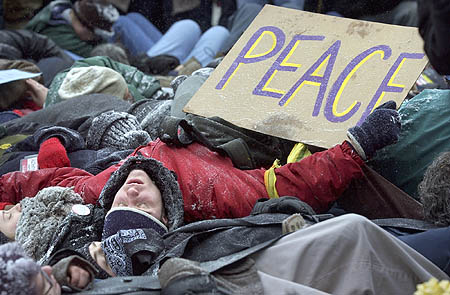
They have not wanted peace at all; they have wanted to be spared war -- as though the absence of war was the same as peace. -Dorothy Thompson
They were all dead.
His bloodied and calloused hands wove the last emerald stem between the mud caked laces of the boots he had recovered from the field. With a small sniff, he sat back on his heels, turning his head slowly to look about the rectangular room. A row of empty boots bordered the wall, each with their laces tangled about the stem of a drooping wildflower.
Altogether there were close to thirty pairs of mud and blood stained boots. The boy lifted his hand and brushed his dirty fingers beneath his lower eyelid wearily, grimacing as his broken nail scratched the puffy, irritated skin. Slowly, he pressed his palms to the floor beneath him and he rose to his feet, his eyes traveling over the tables and chairs that cluttered the small space.
On one of the tables pressed against the wall was littered with yellowy, dusty pages stained with ebony ink and faint, fading pencil scratches. They were all letters and notes from family and lovers and friends. A few photos laid across the letters, but they were crinkled and folded and the places and people printed on the paper were barely distinguishable now. Silently, the boy moved from the room through a little hallway that had been dug into the side of the main room’s dirt wall. The underground base had always made him feel claustrophobic, but now, now that he was alone, it felt too big… too empty.
Like a tomb.
He made a sharp turn to the right and stopped as he reached the small nook that had been dug to store supplies. Sinking to one knee, he touched the warm canteens, lifting them one by one and shaking them by his ear for any sound of moisture. Once he was sure they were all empty, he rose again and brushed off the knees of his pants, succeeding only in smearing blood and mud from his fingers onto the weary cloth. Among the empty canteens were crushed, empty cigarette boxes, empty packets of food; everything was empty now.
The boy wandered aimlessly back to the large room, his eyes again falling on the boots before he looked to the metal ladder that stood in the center of the room that led to the trapdoor that opened to the world of the living.
After a moment’s pause, he moved to the ladder and stretched his hands above his head to curl his fingers about one of the cool, metal rungs. Wearily, the boy ascended, his breath escaping from his lungs in soft gasps. He soon reached the topmost rung and tilted his head back to look up at the dusty trapdoor that was stained with bloody fingerprints.
Lifting one hand from the cool rung, he lifted the latch and ducked beneath the door as it swung inward. He lingered there a moment between the hole and the surface, listening for sounds of footsteps or the thunderous rumblings of vehicles. Both would be immediately apparent in the thick silence that hung over the sandy, barren land above him.
Hearing nothing, he slid his hand out of the door, his fingers dancing across the hot sand until their tips found the rough bark of the roots of a tall, plump, twisted tree. His other hand followed, and both tightened about the root as the boy pulled his upper half out of the hole, collapsing onto the burning sand with a heavy sigh. His legs followed, and soon he was sprawled next to the arching, twisting roots that rose from the sand about the edges of the hole.
After laying there a moment motionless, listening to the emptiness about him, he rose to his feet and lifted one hand to brush it awkwardly through his tangled, blonde hair. Blinking in the harsh light of the sun reflecting against the hard sand, he stepped forward and began to walk.
Bombs and grenades had long destroyed the landscape, leaving it a vast, desolate desert. The boy, as he walked, could not remember how the area had looked before the war; he could not even recall the area’s name. He knew it had once been a great city, and it had had vibrant, green trees and grass. Perhaps it had been a park. He nodded to himself, pressing the side of his wrist against his forehead to try to block the sun from his eyes; a park sounded nice.
He could almost imagine the creaking of swings and the squeaks of a seesaw. It was almost as if he could see their hazy outlines on the horizon just ahead: a bumpy, glistening slide; a bright red swing set; a yellow merry-go-round; and children. He could hear their laughter just over the crunching of the sand beneath his boots.
For a moment, he let himself believe that if he continued he would reach that peaceful place. The illusion was torn away from him too soon; a bead of sweat trickled down into his eyes, causing them to sting terribly. By the time his tears had risen to cleanse his eyes of the painful substance, the image was gone and with it, the laughter.
Out there away from the memories of his fallen comrades, the boy felt the weight of his situation crashing down on his shoulders. His throat was dry, and his tongue clung to the roof of his mouth painfully as he tried to swallow. His saliva had turned to grains of sand, and he coughed, scattering dust from his dirty uniform. The particles immediately rushed to fill his nostrils as he tried to take a deep breath to steady himself, and he sneezed, shuddering softly as blood sprinkled the ground from his nose.
Sniffling, he forced his tongue down and began to heavily breathe, bending and resting his hands on his knees. Tilting up his head, he saw his destination just ahead, and he took an awkward step forward in the same position before standing straight again. His destination was the carcass of a vehicle that had been bringing the enemy supplies. The boy and those with him had somehow managed to take it down and kill is occupants. They had left the bodies and taken most of the supplies back to the base with the intention of returning the next day to retrieve the rest.
They had never gotten the chance.
That night was the night that the resistance was destroyed except for the single boy who was now stepping over a disintegrating ribcage. He paused, looking down at a crumbling skull warily as he approached the vehicle and knelt down beside of it. He pushed back the heavy tarp that had covered the supplies, and he peered into the shaded space a moment then reached inside and pulled free a canteen. Turning, he plopped down onto the hard, dry ground, leaning his back against the skeleton of the vehicle as he unscrewed the top of the canteen and lifted it to his lips. The burning liquid stung his tongue and lips, but he swallowed anyway, grimacing in pain. The second drink was easier, and soon he had drained the canteen. He dropped the canteen to the ground and laid still for a moment to allow the liquid to settle in his stomach before he glanced beneath the tarp again, looking for any sign of food. His eyes caught the dull glint of a wrapper, and his hand shot inside like a striking snake, his fingers immediately closing around the package as he tugged it out. It was a candy bar, melted and flat and one with the wrapper, but to the boy it was like manna from heaven.


No comments:
Post a Comment